
Beautiful Plants For Your Interior
Beautiful Plants For Your Interior
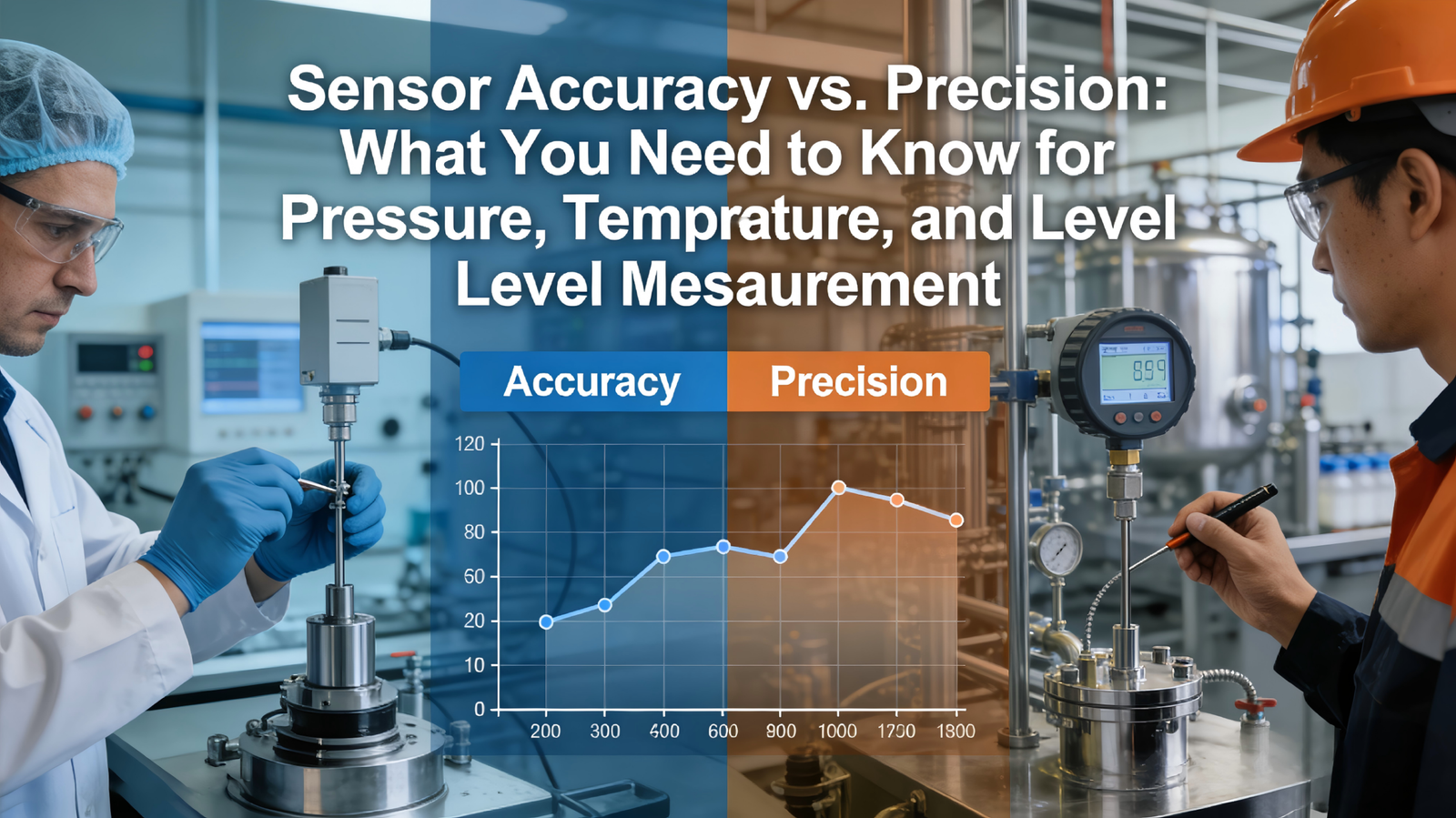
When selecting industrial sensors, buyers often encounter specifications like “accuracy ±0.5% FS” or “precision ±0.1%.” But what do these terms actually mean? And more importantly, how do they impact your measurement quality and operational costs?
At [Your Company Name], we manufacture pressure sensors, temperature sensors, and level sensors across a range of accuracy grades—from general industrial to high-precision laboratory standards. In this post, we demystify accuracy and precision, explain key specifications, and help you choose the right performance level for your specific application in Russia, Southeast Asia, or beyond.
While often used interchangeably in casual conversation, accuracy and precision have distinct meanings in measurement technology.
Accuracy refers to how close a sensor’s measured value is to the true or reference value. A highly accurate sensor will read very close to the actual pressure, temperature, or level.
Precision (or repeatability) refers to how consistently a sensor produces the same reading under the same conditions. A precise sensor may not be accurate if it is consistently offset, but it can still provide reliable comparative data.
Example: Imagine a temperature sensor in a Thai food processing plant. If the true temperature is 100°C:
For most industrial applications, both accuracy and precision matter—but the required level depends on the criticality of the measurement.
When evaluating pressure, temperature, and level sensors, pay attention to these common performance specifications:
Accuracy is typically expressed as a percentage of full scale (FS) or a percentage of reading.
Which to Choose: For applications with wide measurement ranges, % of reading provides better relative accuracy at low values. For narrow ranges, % FS is typically sufficient.
Repeatability measures the sensor’s ability to produce the same output when the same input is applied repeatedly under identical conditions. It is usually expressed as a percentage of FS.
High repeatability is critical for applications like batch processing in food manufacturing or dosing in chemical plants—where consistency matters more than absolute accuracy.
Hysteresis refers to the difference in output when the measured value is approached from increasing versus decreasing directions. For example, a pressure sensor may read slightly different when pressure rises to 50 bar versus when it falls to 50 bar.
Low hysteresis is essential for applications involving cycling conditions, such as hydraulic presses or tank filling and emptying.
This specification indicates how much a sensor’s performance drifts over time due to aging or environmental exposure. A sensor with ±0.1% FS per year stability will maintain its accuracy longer, reducing calibration frequency and lifecycle costs.
For remote installations—such as oil pipelines in Siberia or water monitoring stations in rural Southeast Asia—excellent long-term stability minimizes costly field service visits.
Over-specifying accuracy wastes budget; under-specifying risks product quality and safety. Here is a practical guide:
Even the most accurate sensor can deliver poor results if environmental factors are not considered. In both Russia and Southeast Asia, external conditions play a significant role:
Accuracy specifications refer to performance at the time of calibration. Over time, all sensors drift. A proper calibration program is essential to maintain measurement integrity.
We offer a comprehensive range of pressure, temperature, and level sensors across all accuracy grades—allowing you to select exactly what your application needs. Our advantages include:
Choosing the right sensor performance level doesn’t have to be complicated. Contact our engineering team to discuss your application requirements. We will help you balance accuracy, precision, and cost to find the optimal pressure, temperature, or level sensor for your needs.


Hi, this is a comment.
To get started with moderating, editing, and deleting comments, please visit the Comments screen in the dashboard.
Commenter avatars come from Gravatar.